Nvidia Now Takes Equity Instead of Cash: Is $800 Billion of AI 'Circular Financing' the New Dot-Com?

TL;DR — Nvidia has stopped simply selling chips to cash-strapped AI startups and started financing them: its new AI Computing Partner Program hands GPU capacity to cloud providers in exchange for a cut of their future revenue, backed by a guarantee to buy back any capacity they can't fill. Layer that on top of Nvidia's $40B+ in AI equity bets and OpenAI's $1.15 trillion in vendor commitments, and analysts now estimate the "circular financing" loop across the AI industry at north of $800 billion. It rhymes uncomfortably with the vendor financing that helped inflate — and then detonate — the dot-com telecom bubble. Here's how the loop works, the exact deals inside it, and the one historical parallel worth taking seriously.
What "Compute for Equity" Actually Is
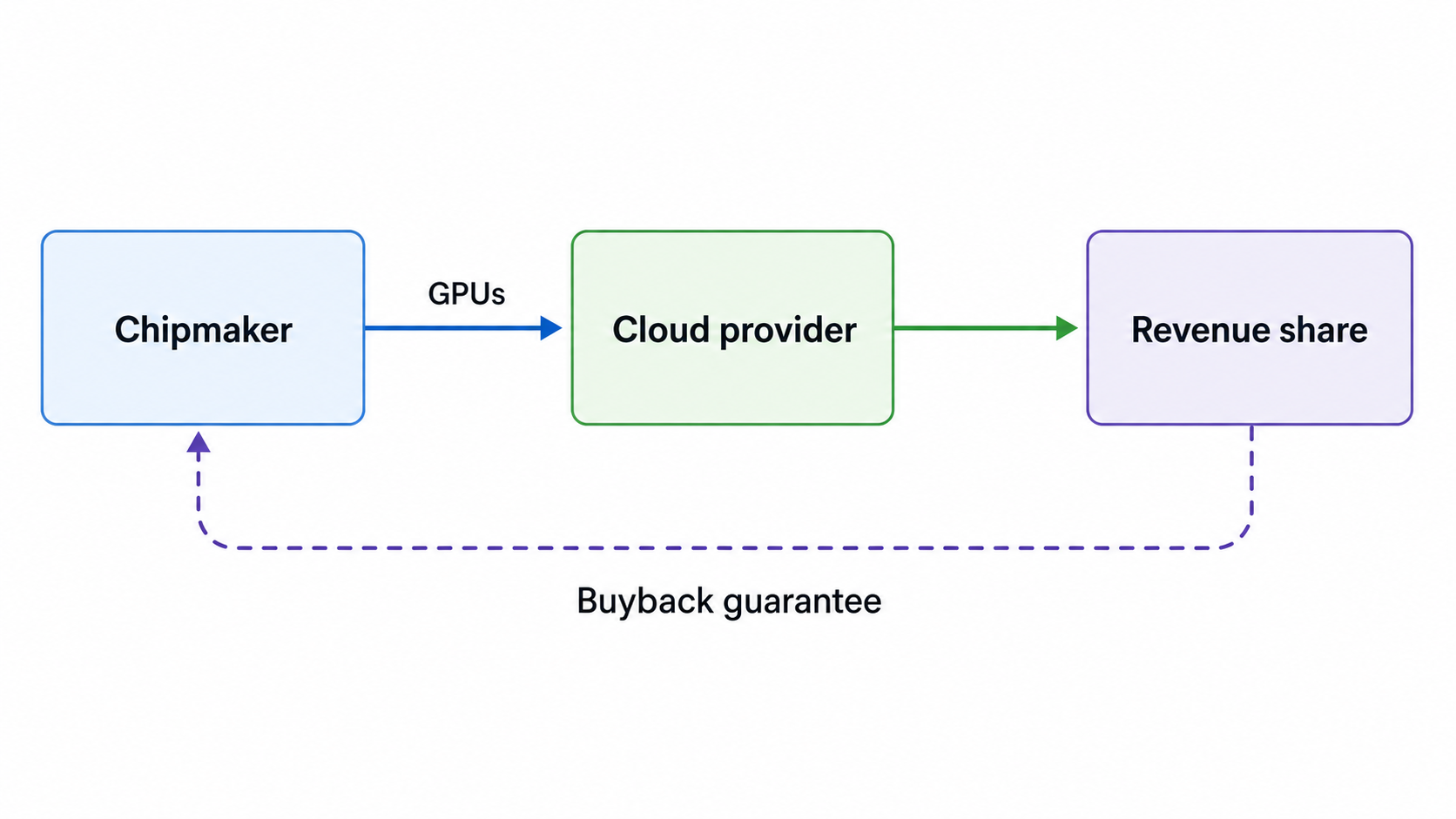
Traditionally the chip business is simple: you pay Nvidia cash, Nvidia ships you GPUs. Nvidia's AI Computing Partner Program rewires that. Instead of demanding full payment upfront, Nvidia gives startup cloud providers guaranteed access to scarce GPUs and, in return, takes a share of the revenue those providers earn renting the chips out — plus, in some structures, equity-like upside.
Two features make it more than a payment plan:
- A repurchase guarantee. If a partner can't fill its GPU slots with paying customers, Nvidia agrees to buy back the unsold capacity at pre-set prices — absorbing the downside risk that would normally sit with the operator.
- A double dip on the same chips. Nvidia collects standard product revenue when it sells the hardware, then collects a further cut of whatever the cloud earns renting it out. The same GPU pays Nvidia twice.
The named launch partners are real and large:
| Partner | Location | GPU commitment | Notable detail |
|---|---|---|---|
| Sharon AI | Australia | Up to 40,000 GB300 GPUs | Sovereign AI infrastructure focus |
| Firmus | Batam, Indonesia | Up to 170,000 GPUs (360 MW site) | ~$25–30B expected offtake over first 6 years |
That's roughly 210,000 next-gen Blackwell GPUs deployed by two partners whose ability to pay is, in part, guaranteed by the chip vendor itself.
## The Bigger Picture: An $800 Billion Money Loop
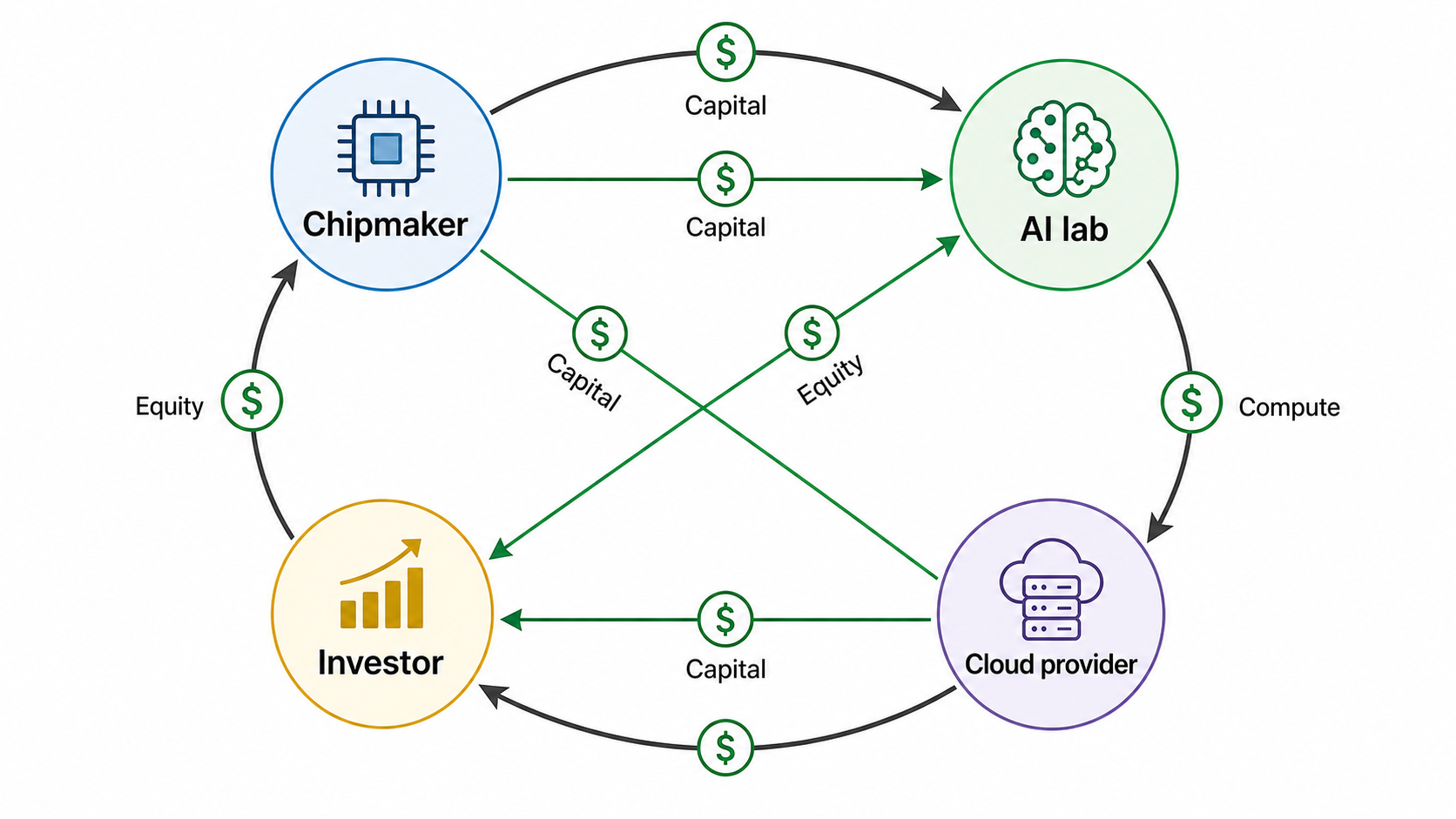
The startup program is one node in a much larger web. Across 2026, analysts estimate total AI circular financing — where the same companies appear on multiple sides of the same deals — at over $800 billion. The canonical shape of the loop: chipmaker → AI lab → cloud provider → back to chips.
The clearest example runs through OpenAI, whose infrastructure commitments total roughly $1.15 trillion allocated across seven vendors from 2025 to 2035:
| Vendor | OpenAI commitment | Also a... |
|---|---|---|
| Broadcom | $350B | Chip supplier |
| Oracle | $300B | Cloud (Stargate) |
| Microsoft | $250B | Cloud + $13B+ OpenAI investor |
| Nvidia | $100B | GPU supplier + OpenAI investor |
| AMD | $90B | Chip supplier |
| Amazon (AWS) | $38B | Cloud |
| CoreWeave | $22B | Cloud (Nvidia holds equity) |
Trace one strand: Nvidia committed $30B as part of OpenAI's $110B financing round in February 2026 while simultaneously being OpenAI's primary GPU supplier. Nvidia also holds equity in CoreWeave, which supplies Oracle, which signed a $300B Stargate commitment with OpenAI. Microsoft has put $13B+ into OpenAI while being its cloud provider — so a big slice of OpenAI's compute spend flows straight back into Azure revenue. The money keeps landing back near where it started.
## Why It Rhymes With the Dot-Com Bust
The bear case has a specific, real precedent — telecom vendor financing during the dot-com bubble. In the late 1990s, equipment makers like Lucent and Nortel lent billions to fledgling telecom carriers so those carriers could buy the makers' own gear. It juiced reported revenue spectacularly on the way up. Then the carriers went bankrupt, the loans became worthless, and the vendors' own share prices collapsed — Lucent's implosion is one of the defining corporate wrecks of that era.
The structural echo is exact:
| Feature | Lucent / Nortel (1999–2001) | Nvidia / AI clouds (2026) |
|---|---|---|
| Vendor funds its own customers | Loans to buy telecom gear | Compute-for-equity + buyback guarantees |
| Effect on revenue | Inflated, demand looked real | Booked offtake, demand looks real |
| Hidden risk | Customer can't repay | Startup can't fill GPU slots |
| Failure mode | Loans written off, stock craters | Buyback obligations hit, equity marks fall |
As Wedbush analyst Matthew Bryson put it, Nvidia's buildouts fit "squarely into the circular investment theme" driving fears about the AI market's durability. The core danger, critics argue, is that vendor financing can manufacture the illusion of demand — when the seller funds the buyer, incentives tilt toward booking the deal rather than proving an end customer actually needs the capacity.
There's a live number that keeps this from being abstract: OpenAI is reportedly on track to lose around $14 billion in 2026 — nearly triple its 2025 losses — while projecting $100 billion in revenue by 2029. The entire loop is underwritten by a bet that that revenue arrives.
Why It Might Not Be Dot-Com 2.0
The comparison isn't airtight, and the bull case is worth stating honestly:
- Nvidia is wildly profitable and self-funding. Lucent borrowed to lend. Nvidia is financing customers out of enormous free cash flow and a fortress balance sheet — it can absorb bad marks that would have sunk a 1999 telecom vendor.
- The GPUs are being used, not shelved. Dark fiber sat unlit for a decade. AI capacity today is running near flat-out, with genuine end demand from enterprises, not just speculative carriers.
- Equity upside, not just debt. Where Lucent held loans that could only be repaid or written off, Nvidia often holds equity — if a partner succeeds, Nvidia captures the upside, not just its money back.
The honest verdict: the mechanism is the same one that blew up in 2001, but the balance-sheet strength behind it is far greater. That doesn't make it safe — it makes the failure mode slower and more absorbable. The thing to watch isn't Nvidia's earnings; it's whether real, paying, end-user demand shows up to justify ~$800B of interlocking commitments before the buyback guarantees start getting called.
Frequently Asked Questions
What is "circular financing" in AI? It's when the same companies fund each other across a chain — a chipmaker invests in an AI lab, the lab buys cloud capacity, the cloud buys the chipmaker's chips — so money loops back to where it started. In 2026 the total across major AI players is estimated north of $800 billion. The risk is that internal money-shuffling can look like external demand.
How is Nvidia's compute-for-equity different from just selling chips? Instead of full cash upfront, Nvidia gives GPU access in exchange for a share of the partner's future revenue, and guarantees to buy back capacity the partner can't sell. Nvidia earns on the chip sale and on the rental income, but also takes on the demand risk it used to push onto customers.
Is this the same as the dot-com telecom bubble? The mechanism — a vendor financing its own customers — is the same one that inflated and then destroyed Lucent and Nortel around 2000. The key difference is that Nvidia funds this from massive profits and a strong balance sheet, and the GPUs are actually being used, whereas dot-com telecom capacity often sat idle.
What's the single biggest risk in the loop? That end demand disappoints. If enterprises don't rent enough compute, startups can't pay revenue shares, Nvidia's buyback guarantees get called, equity stakes get marked down, and the "demand" that justified the whole structure turns out to have been partly self-funded. OpenAI's projected ~$14B 2026 loss is the tension point.
Does circular financing mean AI is definitely a bubble? No. It means a meaningful slice of visible AI demand is internally financed rather than proven by outside buyers — which raises the stakes if growth slows, but doesn't by itself prove the demand is fake. Watch the application layer: whether businesses actually pay for AI output is what ultimately validates or breaks the loop.
Key Takeaways
- Nvidia's AI Computing Partner Program swaps upfront cash for revenue share plus a capacity-buyback guarantee — vendor financing with equity-style upside, with ~210,000 Blackwell GPUs already committed via Sharon AI and Firmus.
- Total AI circular financing across the industry is estimated at over $800 billion; OpenAI alone has ~$1.15 trillion in vendor commitments, with Nvidia, Microsoft, and Oracle sitting on multiple sides of the same deals.
- The structure echoes late-1990s telecom vendor financing (Lucent, Nortel), which inflated revenue and then collapsed when customers couldn't pay.
- The crucial difference: Nvidia funds this from huge profits and the GPUs are actually in use — so the failure mode is slower and more absorbable than dot-com's.
- The real thing to watch is end demand: OpenAI is on track to lose ~$14B in 2026, and the whole loop rests on a bet that paying customers show up.
Sources 1. Startup Fortune: Nvidia Will Take a Cut of AI Startups' Future Revenue Instead of Cash Upfront 2. MLQ.ai: Nvidia Launches Revenue-Share Program Offering AI Startups GPU Access Without Upfront Payment 3. CNBC: Nvidia embraces AI investor, topping $40 billion in equity bets 4. Bloomberg: AI Circular Deals: How Microsoft, OpenAI and Nvidia Keep Paying Each Other 5. IDC: Do AI Markets Face a Circular Financing Problem? 6. Alatirok: AI Circular Financing: The Nvidia-OpenAI-Oracle Money Loop
Tags: #AI #Nvidia #CircularFinancing #VendorFinancing #Investing #Explainer



Comments ()