Are 'AI-Proof' Jobs Real? A 21,500-Company Study Says Where You Work Matters More Than What You Do

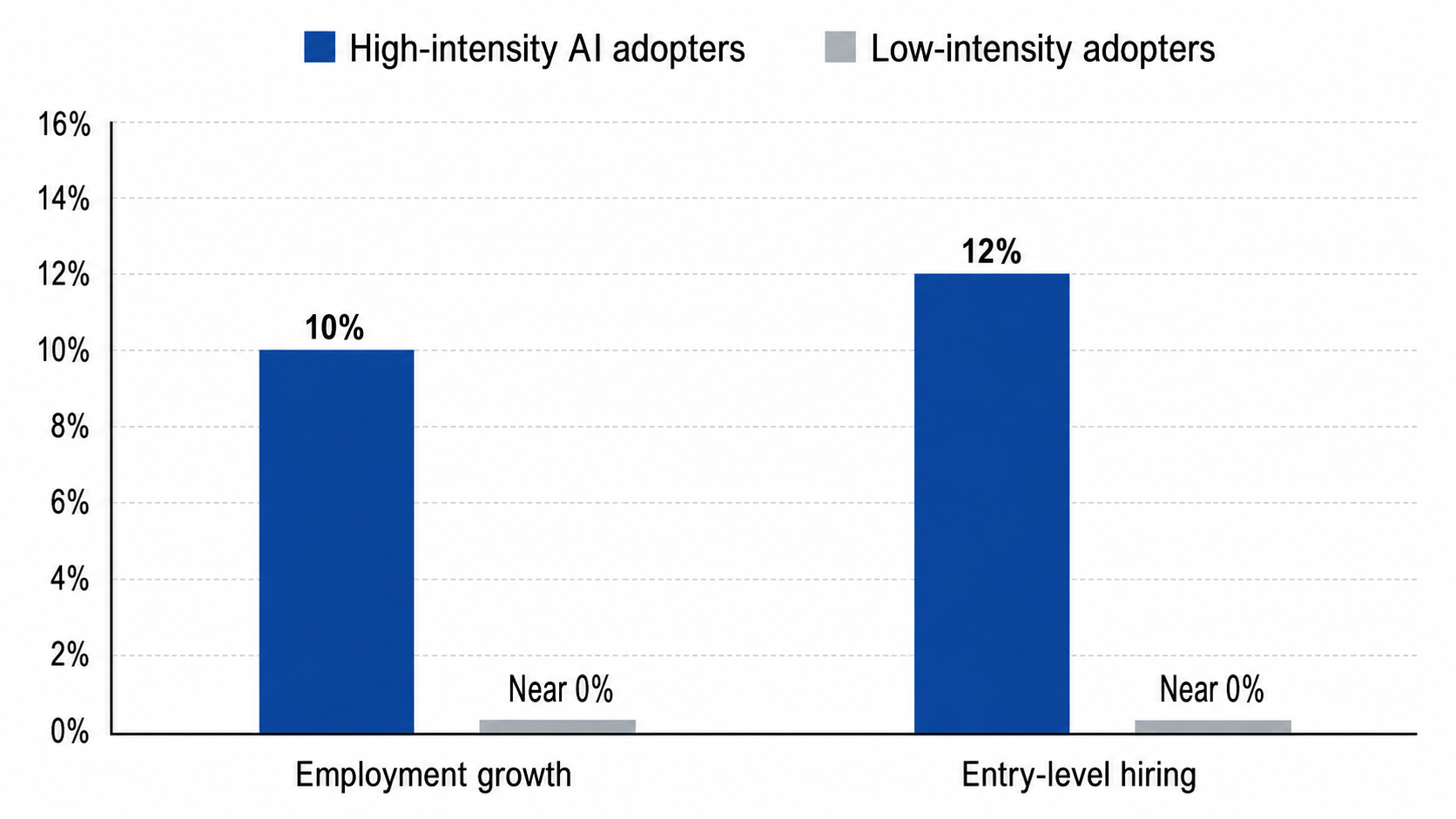
TL;DR — The popular framing of "AI-proof jobs" — pick the right occupation and you're safe — may be aiming at the wrong variable. A study of 21,559 U.S. companies by Ramp and Revelio Labs found that firms investing most heavily in AI grew headcount about 10% and entry-level hiring about 12%, while low-intensity adopters saw no meaningful employment gains at all. In other words, the same job title can be shrinking at an AI-laggard and expanding at an AI-leader. Here's what the data actually says, the big caveat that keeps it from being a slam dunk, and how to tell which side of the line your employer is on.
The Conventional "AI-Proof Job" Advice Is Half the Picture
Search "AI-proof jobs" and you'll get list after list organized by occupation: nurses, electricians, plumbers, therapists, elementary teachers — roles that supposedly can't be automated. The implicit model is that safety is a property of the job you do.
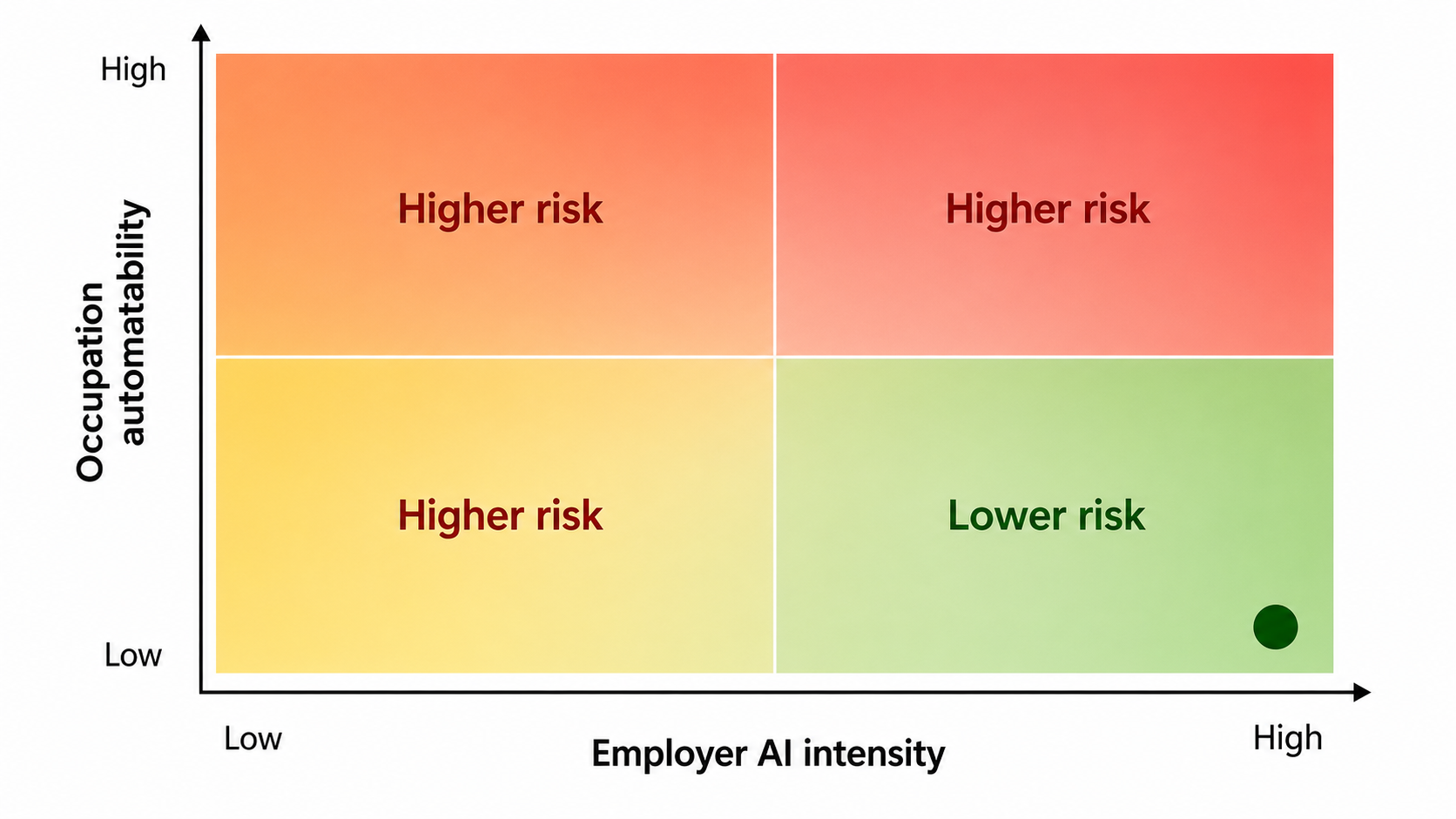
That's not wrong, but it quietly ignores the other axis: the company you do it at. A software engineer, a marketer, or a financial analyst can be a layoff line-item at one firm and a growth hire at another — same skills, opposite fate — depending on whether their employer is using AI to cut costs or to unlock new growth. The occupation-only lists can't see that split. The 2026 data does.
## What the 21,559-Company Study Actually Found
Ramp, a financial-operations platform, teamed with labor-analytics firm Revelio Labs to track 21,559 U.S. companies from 2021 to early 2026, sorting them by how intensively they'd adopted AI. The headline result cuts directly against the "AI is gutting white-collar work" narrative:
| Metric | High-intensity AI adopters | Low-intensity adopters |
|---|---|---|
| Overall employment growth | ~+10% | No statistically significant gain |
| Entry-level hiring | ~+12% | Flat |
| Wage trend | Growing faster | Lagging |
| Headcount vs. peers | Outpacing least-exposed firms | Trailing |
The takeaway the researchers drew: at least so far, AI is behaving as a job expander at the companies deploying it most aggressively — used to enter new markets and unlock growth rather than to thin out staff. Notably, the entry-level number (+12%) is the one that most directly contradicts the widespread fear that AI is closing the bottom rung of the career ladder first.
Adoption isn't evenly spread, which matters for where these effects show up:
- Leading sectors: information technology, finance, professional services.
- Lagging sectors: hospitality, arts, healthcare.
So the "employer axis" and the "sector axis" overlap — the industries adopting AI fastest are also where the hiring gains concentrate.
## The Caveat That Keeps This Honest: Correlation ≠ Causation
Before anyone treats "join an AI-heavy company" as guaranteed job security, the researchers themselves flagged the load-bearing limitation: this is correlation, not causation.
The companies pouring money into AI were, on average, already larger, faster-growing, more technical, and more likely to be venture-backed before they deployed the technology. Fast-growing companies hire more people — with or without AI. So part of the "+10%" almost certainly reflects that AI adopters were winners to begin with, not proof that adopting AI causes you to hire.
The study tried to control for this by comparing early adopters against similar non-adopting firms rather than against companies that never touched AI — a real improvement over naive comparisons, but not a randomized experiment. Two more honest wrinkles:
- Gains emerged gradually over 6–12 months, implying firms need time to integrate AI before any productivity or growth benefit shows — the effect isn't instant.
- It's a snapshot of 2021–early 2026. A technology in its expansion phase often adds jobs before any later automation-driven consolidation. Today's "expander" pattern is not a promise about 2028.
So the defensible reading isn't "AI creates jobs." It's narrower and more useful: at this stage of the cycle, the companies deploying AI aggressively are the ones growing headcount — and that's a meaningfully safer place to be standing than at a stagnant AI-laggard.
How to Tell Which Side of the Line You're On
If the employer axis matters as much as the study suggests, the practical question shifts from "is my job title safe?" to "is my employer using AI to grow or to cut?" Signals worth reading:
- Direction of AI framing. Is leadership talking about AI to do more (new products, new markets, faster shipping) or explicitly to reduce headcount? Growth-framing firms are the ones the data associates with hiring.
- Entry-level pipeline. Is the company still hiring juniors and interns? The +12% entry-level figure at heavy adopters is the tell — a firm quietly freezing its bottom rung is signaling the cost-cut posture, not the growth one.
- Sector. IT, finance, and professional services are where adoption and hiring gains concentrate; hospitality, arts, and healthcare lag on adoption (which is a different risk profile, not automatic safety).
- Are you closer to revenue or to cost? Within any firm, roles that help the company sell more tend to survive automation drives better than roles framed purely as overhead.
None of this replaces the old occupation-level advice — a job that's genuinely hard to automate and sits at a growth-mode employer is the safest square on the board. The point is that the second axis is doing at least as much work as the first, and most "AI-proof jobs" listicles never mention it.
Frequently Asked Questions
Are "AI-proof jobs" a real thing? Partly. Some occupations are genuinely hard to automate, but 2026 data suggests where you work matters at least as much as what you do. Companies investing heavily in AI grew employment ~10% and entry-level hiring ~12%, while low-adoption firms were flat — so the same role can be shrinking at one employer and growing at another.
Does working at an AI-heavy company actually make my job safer? The correlation points that way — heavy AI adopters are hiring more, not less — but it's not proven cause and effect. Those firms were already larger and faster-growing before adopting AI, so some of the hiring reflects that they were winners to begin with. It's a favorable signal, not a guarantee.
Isn't AI supposed to be eliminating entry-level jobs? That's the widespread fear, but the Ramp/Revelio study found entry-level hiring grew about 12% at the heaviest AI adopters — the opposite pattern at those specific firms. The caveat is that this is a 2021–early-2026 snapshot during AI's expansion phase; it doesn't rule out later consolidation.
Which industries are safest right now? Adoption and hiring gains cluster in IT, finance, and professional services. Hospitality, arts, and healthcare lag on AI adoption — which means a different risk profile, not automatic safety. Sector, employer growth-mode, and occupation all stack together.
What's the single best thing I can do for job security around AI? Combine both axes: be in a role that's hard to fully automate and at an employer using AI to grow rather than to cut costs. Watch whether your company frames AI as expansion or as headcount reduction, and whether it's still hiring juniors — those are the clearest tells.
Key Takeaways
- "AI-proof job" advice focuses on occupation, but a 21,559-company study suggests employer is an equally important axis.
- Heavy AI adopters grew employment ~10% and entry-level hiring ~12%; low-intensity adopters saw no significant gains — the same job title can shrink or grow depending on the firm.
- The +12% entry-level figure directly contradicts the "AI is closing the bottom rung" narrative — at least at the companies adopting most aggressively.
- Big caveat: correlation, not causation. AI adopters were already larger, faster-growing, and better-funded, and the data is a 2021–early-2026 snapshot during AI's expansion phase.
- Practical move: combine a hard-to-automate role with a growth-mode employer (still hiring juniors, framing AI as expansion) in a leading sector like IT, finance, or professional services.
Sources 1. CoinDesk: Companies spending the most on AI are growing jobs, Ramp study finds 2. PwC: 2026 Global AI Jobs Barometer 3. Los Angeles Times: Want an AI-proof job? New research says you may be safer at companies embracing the technology
Tags: #AI #Jobs #Career #FutureOfWork #LaborMarket #Explainer



Comments ()