The AI Sell-Off With No Catalyst — and Why Korea Fell Hardest
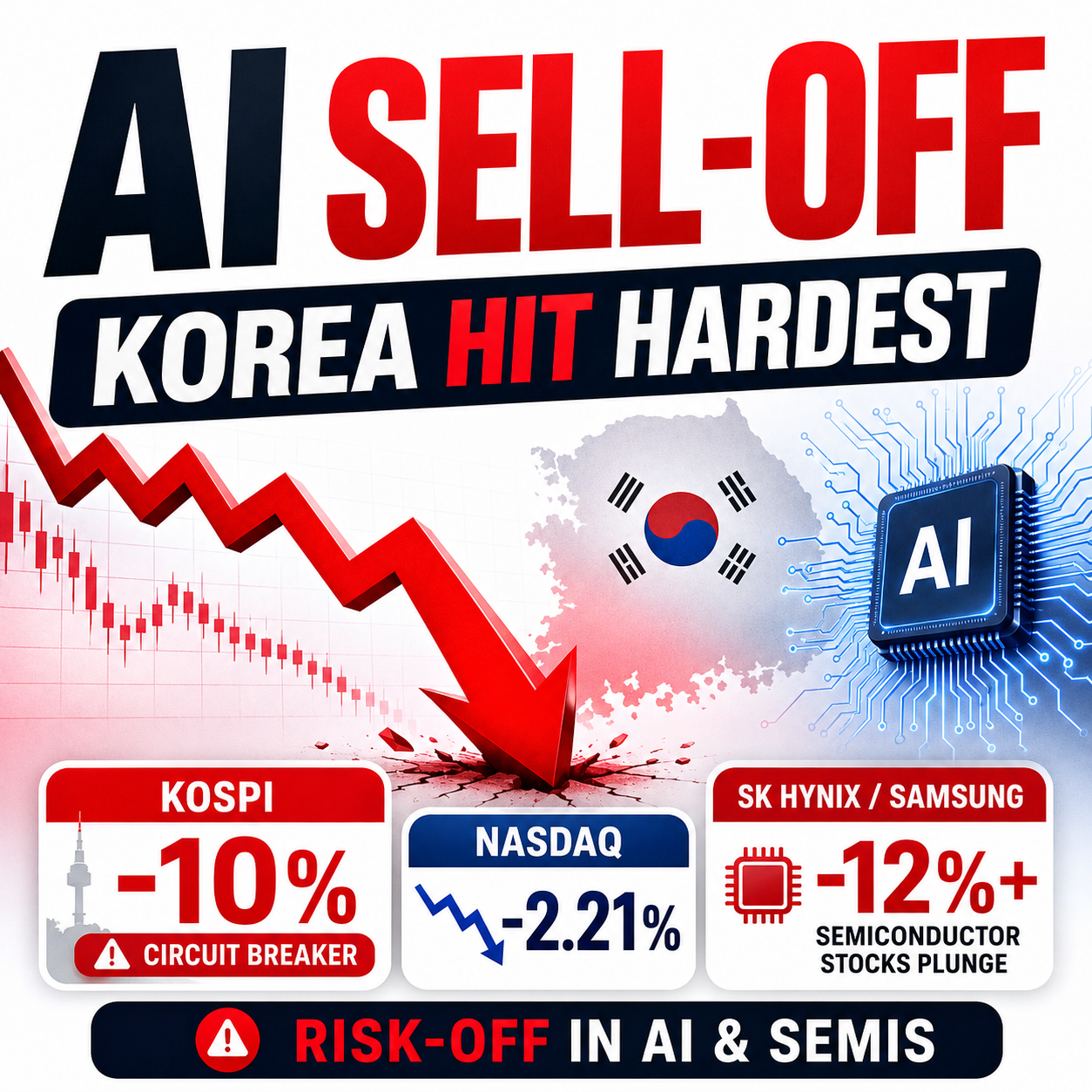
TL;DR — In late June 2026, AI stocks sold off hard with no clear trigger. The Nasdaq fell into correction from its June 2 high, but Asia took the worst of it: Korea's Kospi plunged 10% and tripped a circuit breaker before bouncing 3% the next day. The lesson is less about AI and more about crowded trades.
There was no bad earnings report, no shock rate decision, no single headline. And yet on Tuesday, June 23, the AI trade buckled. The Nasdaq dropped 2.21% and the S&P 500 fell 1.44%, leaving the Nasdaq about 5.5% below its record high from June 2 — though still up 10% on the year, per CNN Business. Microsoft and Meta slid into bear-market territory, down a fifth from their peaks, while the rest of the Mag 7 — Amazon, Apple, Google, Nvidia, Tesla — all fell into correction.
So what? The absence of a catalyst is the story. When a trade gets this crowded, it doesn't need bad news to unwind — it just needs everyone reaching for the exit at once. That's a positioning problem, not a fundamentals problem, and positioning problems tend to snap back fast.
Nowhere was that clearer than Asia, where leverage and concentration amplified the move.
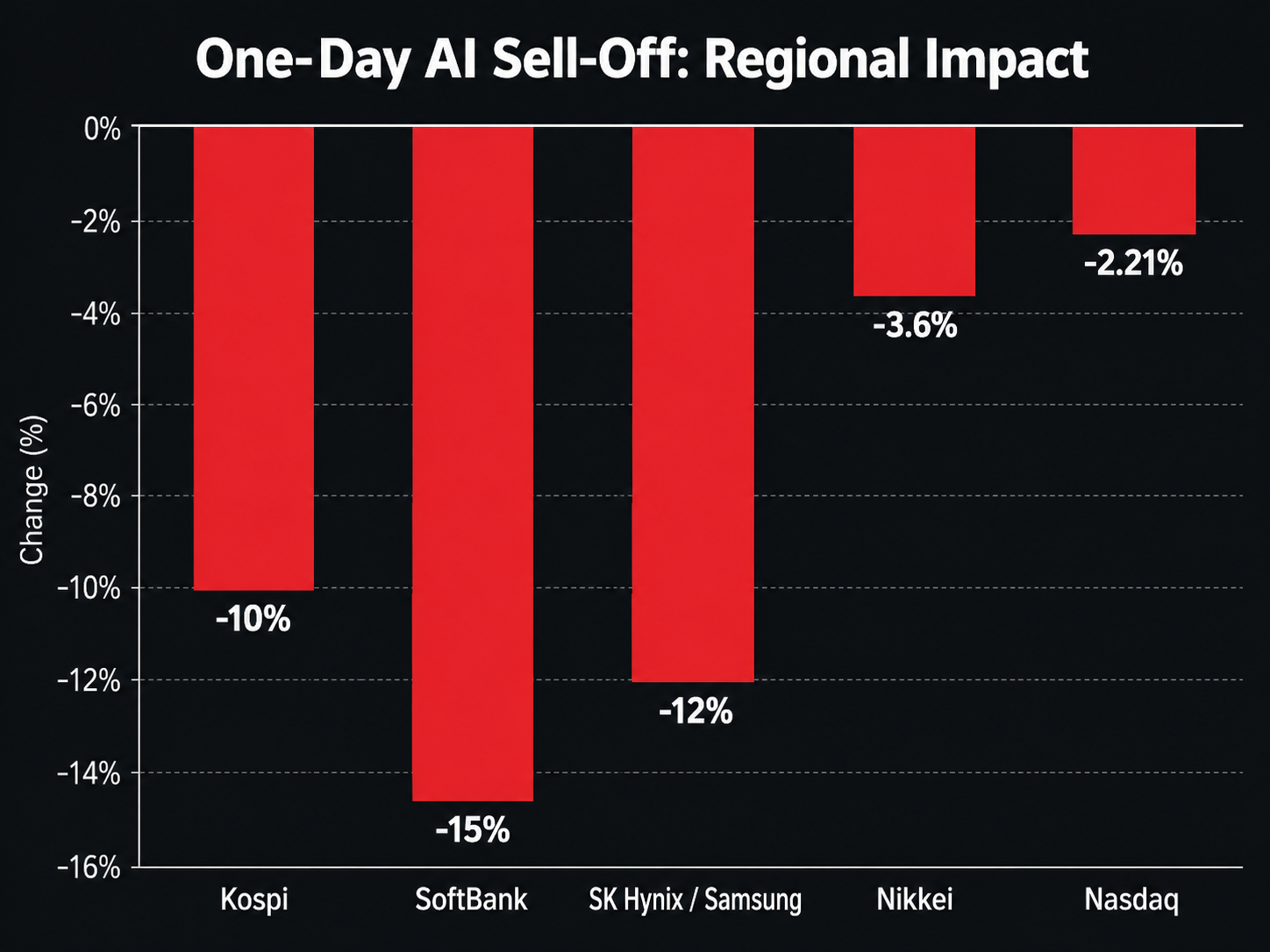
| Market / stock | Tuesday move | Note |
|---|---|---|
| Korea Kospi | -10% | Circuit breaker tripped |
| SK Hynix / Samsung | -12%+ | Memory-chip concentration |
| Japan Nikkei 225 | -3.6% | |
| SoftBank | -15% | Leveraged AI exposure |
| US Nasdaq | -2.21% | Correction from June 2 high |
Korea fell hardest for a structural reason: its index is heavy with memory-chip makers whose fortunes are strapped to the AI capex cycle. When traders sell "AI," they sell SK Hynix and Samsung, and the Kospi has nowhere to hide. The 10% plunge tripped a circuit breaker — a rare, blunt signal of panic rather than analysis.
Then came the tell. By Wednesday morning the Kospi bounced 3% and Samsung surged 7%, recovering much of the loss — the latest in a series of sharp dips this year that reversed almost as fast as they arrived. That doesn't prove the AI trade is safe. It proves it's crowded, jumpy, and driven by positioning more than by any thesis about the technology itself.
Bottom line: In a crowded trade, the scariest days often have no reason at all — and the snap-back is the reason you don't sell into them.
Tags: #Markets #AIStocks #Investing #Semiconductors #Korea



Comments ()