A 3D Chip Breakthrough Just Bought Moore's Law Time
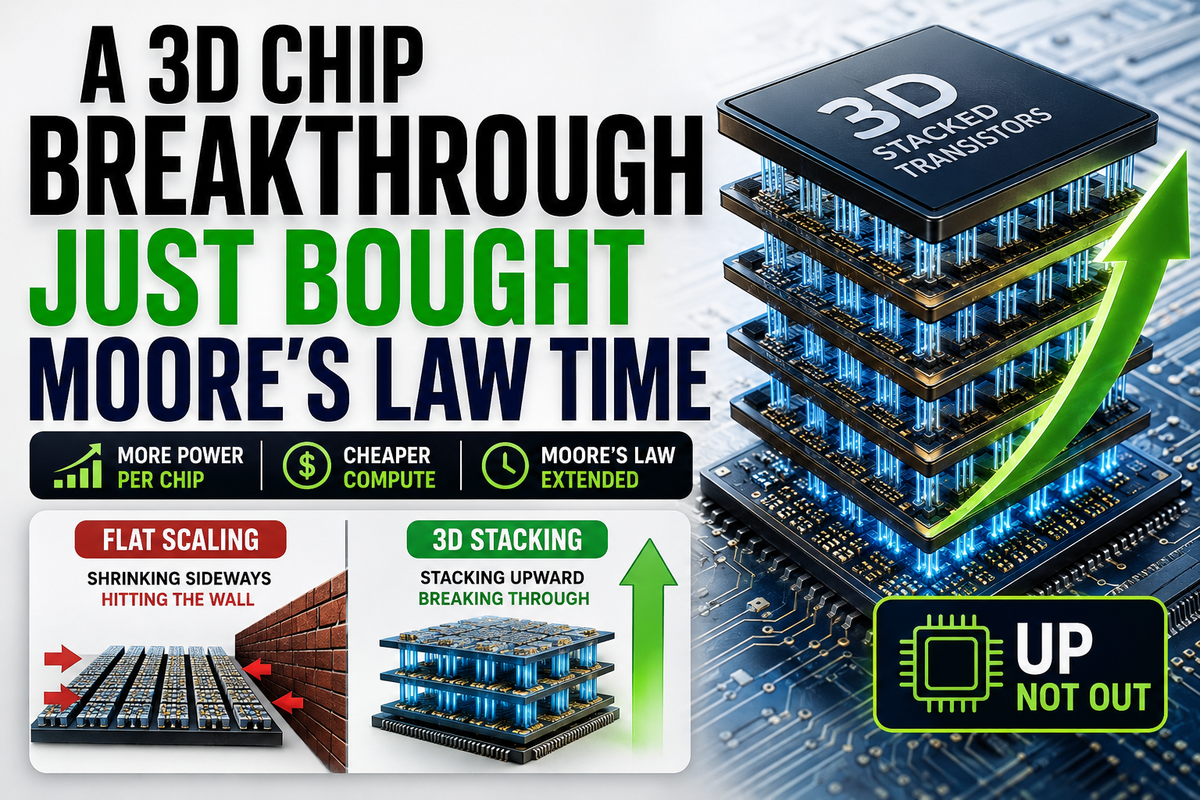
TL;DR — Researchers report a new 3D silicon chip design that could extend Moore's Law for years by stacking transistors upward instead of just shrinking them. If it scales, it's a quiet answer to one of the biggest fears hanging over the AI boom: that we're running out of room to make chips faster and cheaper.
For decades the entire tech economy rode one assumption — that chips get roughly twice as powerful every couple of years. That's Moore's Law, and for the last several years engineers have been warning it's hitting a wall, because you can only shrink a transistor so far before physics stops cooperating. Now a [new 3D silicon chip breakthrough](https://www.sciencedaily.com), reported via ScienceDaily, suggests a way around the wall: stop shrinking sideways and start building up.
So what? The classic way to make chips better was to make features smaller, packing more transistors into the same flat square. We're now near atomic limits where that game gets exponentially harder and more expensive. The 3D approach changes the question from "how small can we go?" to "how high can we stack?" — layering transistors vertically so you get more computing power per chip without needing an impossible new shrink. It's the difference between cramming more rooms onto one floor and simply adding floors to the building.
This matters far beyond the lab, and the timing is almost poetic. This same week, chip stocks sold off on fears the AI boom is overbuilt and overfinanced. A credible path to keep improving chips is exactly the kind of news that underpins the bull case: AI's appetite for compute is bottomless, and the industry's biggest long-term risk is hitting a hardware ceiling. Push that ceiling higher and you extend the runway for everything built on top — cheaper AI, longer phone battery life, more capable devices that don't need a data center to think.
| The old playbook | The 3D shift |
|---|---|
| Shrink transistors (sideways) | Stack transistors (upward) |
| Hits atomic physical limits | Adds capacity via vertical layers |
| Slowing, very expensive gains | Potential to extend Moore's Law for years |
The honest caveat: a breakthrough in a paper is not a breakthrough in your laptop. Chip research is littered with promising designs that never survived the jump to mass manufacturing, where heat, yield, and cost decide everything. Stacking transistors creates real thermal challenges — more layers means more heat in less space. Realistic timeline to commercial products is years, not months, and "could extend Moore's Law" is a forecast, not a delivery date.
But the direction of travel is what counts. The industry has been quietly migrating toward 3D for a while — stacked memory and chiplets are already shipping — and this kind of result reinforces that the future of chips is vertical. For investors, it's a reminder that the semiconductor story isn't just about who sells the most GPUs today; it's about who masters the next manufacturing paradigm. For everyone else, it's reassurance that the steady march of faster, cheaper computing — the thing that quietly made the last 40 years of tech possible — isn't out of road just yet.
Bottom line: Moore's Law isn't dead; it's just learning to climb instead of shrink, and that's the most important kind of boring breakthrough there is.
Source: ScienceDaily, May 2026
Comments ()